

Education
Page Introduction
Buying a diamond — whether lab-grown or natural, whether for an engagement ring or a significant investment — is a decision that rewards preparation. The more accurately you understand what determines a stone's real-world appearance and value, the better positioned you are to evaluate what you are being offered.
This page explains the technical framework we apply to every sourcing engagement, and why it consistently produces better outcomes than grade-label selection alone.

Procurement vs. Retail Inventory — Why It Matters
Retail diamond inventory — whether in a physical store or an online marketplace — is limited to what the retailer has purchased, priced, and chosen to stock. That inventory reflects the retailer's margin requirements and buying patterns, not your specification.
Private procurement inverts that dynamic. Instead of choosing from available stock, your specification drives what is sourced. The result is a stone that was selected for your priorities — not one you've settled for because it was the closest available match.

Beyond the 4Cs — Why Proportions Determine Performance
The 4Cs — cut, color, clarity, carat — are a standardized communication framework. They are useful for broad comparison, but they are not a complete performance model. Cut grade in particular is a composite rating that can obscure meaningful differences in proportion geometry between stones that carry the same label.
Two diamonds graded Excellent cut by the same laboratory may have measurably different table percentages, depth configurations, and crown-to-pavilion angle relationships — all of which determine how light moves through the stone and how the stone actually looks face-up. Grade labels tell you the conclusion. Proportion analysis shows you the reasoning behind it.

Cut Performance — The Variable That Matters Most
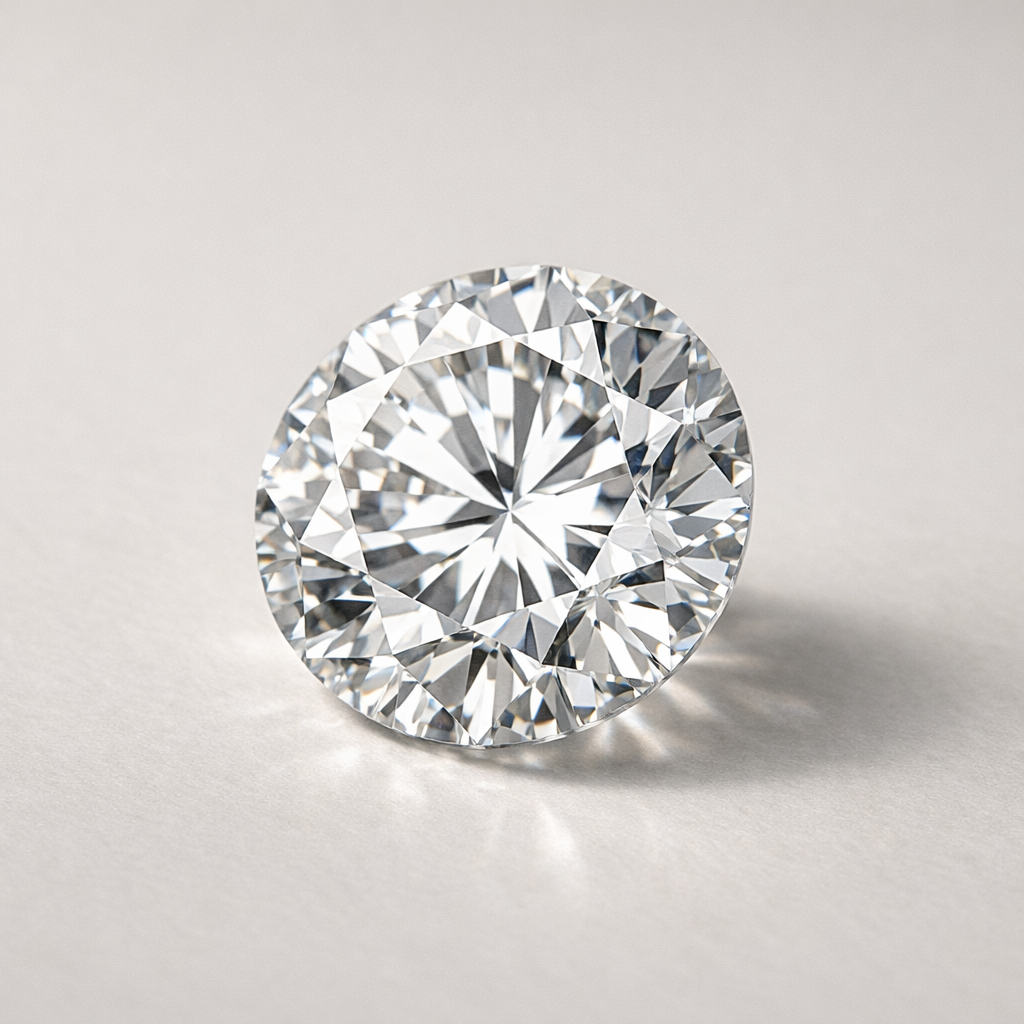
Of all the factors that determine how a diamond looks, cut quality has the greatest influence — and it is the variable most commonly underweighted by buyers who optimize heavily for color or clarity grade.
A well-proportioned stone returns light efficiently, producing the brilliance, fire, and scintillation that make a diamond visually compelling. A stone with compromised proportions — even one with superior color and clarity grades — will underperform relative to its certificate. Our sourcing process treats cut performance as the primary filter, not a secondary consideration.

Face-Up Size — What You Actually See
Carat weight measures mass, not diameter. Two stones of identical carat weight can have meaningfully different face-up appearances depending on their proportions. A stone with a shallower depth percentage will typically appear larger face-up than a deeper stone of the same weight — which is why carat weight alone is an incomplete proxy for visual size.
We evaluate face-up appearance as part of every sourcing specification, ensuring that the stone you receive looks the way you expect it to — not just weighs what the certificate says.

Certification — IGI and GIA
We work exclusively with diamonds certified by IGI (International Gemological Institute) and GIA (Gemological Institute of America). Both laboratories apply rigorous, standardized grading methodologies and are recognized globally as the benchmark for independent diamond certification.
Certification tells you the grades assigned to a stone at the time of evaluation. Our sourcing process applies proportion analysis and performance review on top of that certification data — not in place of it. Every stone we source carries a verified report from one of these two laboratories.
Lab-Grown vs. Natural Diamonds
Lab-grown and natural diamonds are physically, chemically, and optically identical. The difference is origin: natural diamonds form over geological timescales beneath the earth's surface; lab-grown diamonds are produced in controlled environments that replicate the same crystalline process.
In practice, the relevant differences are price, market availability, and resale dynamics. Lab-grown diamonds are generally available at a significant price reduction relative to comparable natural stones — making them well-suited for clients optimizing for size or specification at a defined budget. Natural diamonds carry the valuation framework associated with geological rarity and origin provenance.
We present both categories with equal technical rigor and without advocacy for either. Our role is to help you understand the factual trade-offs so the decision reflects your actual priorities.

When you're ready to apply this framework to your own search — with your specific stone type, shape, size, and budget in mind — a private consultation is where that work begins.
No commitment required. We begin with a conversation.